





Communication is the heartbeat of the parent-child relationship. For parents of nonverbal children, the journey to "hear" what their child is thinking can be a path of deep intuition. This Autism Acceptance Month, we are exploring how Augmentative and Alternative Communication (AAC) serves as the ultimate bridge, moving us past "awareness" and into a space where every child’s inner world finally finds its way out.
Key Takeaways
-
AAC includes any tool or method used to express thoughts besides speech. It requires no prerequisites.
-
Research shows it actually supports and encourages verbal development rather than hindering it.
- It's effective because it lowers the fine-motor stress of speaking.
- It allows children to transition from passive observers to active students who can demonstrate their knowledge, build peer friendships, and advocate for their own needs.
- April 2026 is the most cost-effective window of the year to secure AAC tools at 50% to 75% off.
What is AAC?
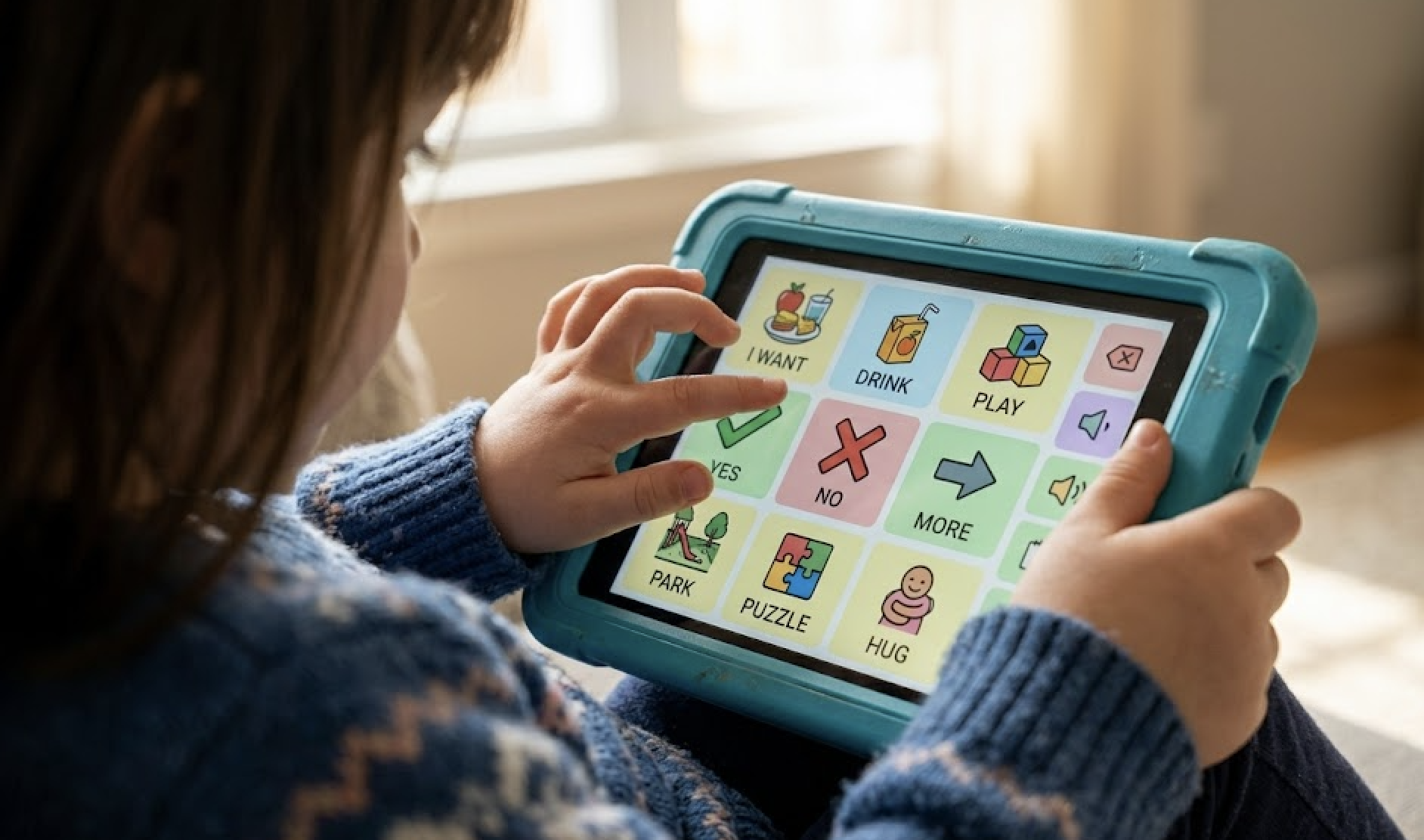
Augmentative and Alternative Communication (AAC) is simply any tool, strategy, or method other than spoken words that helps a person share their thoughts, needs, and ideas. Whether it’s a high-tech tablet or a simple hand gesture, AAC provides a voice to those who cannot rely on speech alone.
Key Considerations:
-
It Supports Speech A common myth is that AAC hinders verbal development. In reality, research shows that AAC often encourages verbal speech by reducing the pressure to produce sounds while providing a consistent language model.
Why it works? (The Science of "Pressure")
In a landmark study by Millar, Light, and Schlosser1, they sought to determine if AAC intervention resulted in a decrease, no change, or an increase in natural speech production.. 89% of participants (aged 2-60 years; most with autism) showed increased speech after starting AAC, 11% showed no change, 0% showed a decrease in speech. The AAC interventions involved instruction in manual signs or non-electronic aided systems.
Research points to three reasons why AAC leads to more talking:
- Reduced Frustration: Speaking is a fine-motor skill. AAC takes the "stress" out of the physical act, allowing our kids to focus on the social connection.
- Auditory Feedback: Every time a child presses a button on a device or points to a symbol on a communication board, they hear the word spoken the same way every time. This helps with "auditory mapping" in the brain. It links the symbol to the sound and meaning of the word.
- Cause and Effect: It teaches our kids that "When I use a word, I get a result." Once they realize the power of communication, they become more motivated to use whatever tool is fastest, which is eventually their own voice
At Home: The Power of Modeling
Think of AAC like a second language. Our kids won't know how to use it if they don't see us using it. At home, "modeling" (also known as Aided Language Input) is your most powerful tool.
- Narrating Daily Routines: Use the device to talk through what you are doing. While making a snack, tap "Eat," "Apple," or "Open." This shows that the device isn't just for "testing," it’s for living.
- Interactive Playtime: During play, use the device to comment rather than just ask questions. Instead of "What color is this?", tap "Go fast!" with cars or "Big tower!" with blocks to model descriptive language.
- Emotional Connection: Model feelings when they happen. If you are tired, tap "Tired" on their device. If they seem happy, tap "Happy." This helps them connect the abstract feeling to a concrete button they can use later.
- Giving Choices: Offer autonomy by letting them choose between two items using the device. This replaces the "point and grab" with a clear, empowered request.
In the Classroom: Leveling the Playing Field
In school, AAC is an academic equalizer. It transforms our kids from a "passive observer" into an "active student" who can show what they truly know.
- Circle Time & Participation: With programmed phrases or core words, children can participate in morning greetings, weather reports, or singing along with the class.
- Demonstrating Academic Knowledge: AAC allows teachers to assess our children's understanding of the curriculum. They can answer "Which animal is a mammal?" or "What is 2+2?" just as easily as their verbal peers.
- Peer-to-Peer Interaction: The device acts as a social bridge during recess or lunch. High-tech devices can be programmed with "social scripts" like "Can I play?" or "That’s cool!", helping them build friendships.
- Self-Advocacy: School can be overwhelming. AAC gives our kids the power to ask for a "Break," say "Too loud," or request "Help" without relying on physical frustration to get their point across.
In honor of Autism Acceptance Month (April), several major AAC developers have announced significant discounts for 2026. Most of these sales offer 50% off the one-time purchase price or the first year of a subscription. Each offers a unique approach to language development, from motor-planning to symbol-based communication.
While some discounts don't start until later in the month, most apps offer a free trial to take advantage of before you buy.
AssistiveWare: Proloquo2Go & Proloquo (April 20 - April 27)
Considered the gold standard for symbol-based communication, Proloquo2Go is highly customizable and grows with the user.
-
Proloquo: A newer, simplified version designed for quick start and ease of use.
-
Proloquo2Go: The full-featured version with over 10 years of proven success in classroom settings.
TouchChat with WordPower
Known for its intuitive layout, TouchChat is excellent for children who benefit from a variety of vocabulary options and clear visual icons.
Key Features:
- WordPower Suites: Different "cell" counts (e.g., 42, 60, or 80 buttons) to match your child's visual and motor precision.
- Multi-Lingual Support: Excellent options for bilingual families.
LAMP Words for Life
Based on the "Language Acquisition through Motor Planning" principle, this app is designed for children who thrive on consistency and muscle memory.
Key Features:
-
Fixed Icon Placement: Icons never move, allowing the child to find words through habit rather than scanning.
-
Vocabulary Builder: A feature that allows you to "hide" buttons temporarily to avoid overwhelm during initial learning.
Pro-Tips for Your Purchase
- Educational Discounts: If you are buying for a school or organization, many of these apps (like those from AssistiveWare and Smartbox) offer an additional 50% off when you buy 20 or more copies through Apple School Manager, bringing the total discount to roughly 75% off.
- Try Before You Buy: Most of these apps offer a free trial (usually 14–30 days). We recommend starting a trial now so you know which app fits your child’s needs before the sale starts.
- Device Compatibility: Ensure your iPad or tablet is updated to the latest OS version, as these robust apps often require modern hardware to run smoothly.
References & Links
Further evidence-based insights supporting the use of AAC can be found here:- 1Millar, D., Light, J., & Schlosser, R. (2006). The Impact of Augmentative and Alternative Communication Intervention on the Speech Production of Individuals With Developmental Disabilities: A Research Review. Journal of Speech, Language, and Hearing Research, 49, 248-264.
- Baumann Leech, E. & Cress, C. (2011). Indirect Facilitation of Speech in a Late Talking Child by Prompted Production of Picture Symbols or Signs. Augmentative and Alternative Communication, 27 (1), 40-52.
- Sigafoos, J., Didden, R., & O'Reilly, M. (2003). Effects of Speech Output on Maintenance of Requesting and Frequency of Vocalizations in Three Children with Developmental Disabilities. Augmentative and Alternative Communication, 19(1), 37-47.
- Romski, M., Sevcik, R., Adamson, L., Cheslock, M., Smith, A., Barker, R., & Bakeman, R. (2010). Randomized Comparison of Augmented and Nonaugmented Language Interventions for Toddlers With Developmental Delays and Their Parents. Journal of Speech, Language, and Hearing Research, 53, 350-364.
- prc-saltillo.com/App-Sale-Terms-Conditions
- assistiveware.com/aac-app-sale
- thinksmartbox.com/news/grid-for-ipad-50-off-app-sale-april-2026/